


Ask a removalist "how big is the house?" and you'll get a crew size. Ask us and you'll get a second question: what's between the front door and where the truck can stand? On a flat street with a wide drive, the answer is "ten easy metres" and the bedroom count does the sizing. On a ridge street, the answer is the whole quote.
What slope actually does to a move
Three things, all of them measured in minutes that add up to hours:
- The truck parks further away. A steep or narrow drive means the truck stands at the kerb below, sometimes a house or two along. Every piece now travels the slope on foot.
- Every carry is slower and one-way heavy. Downhill with a wardrobe is a controlled lower, not a walk. Two movers on a steep carry move fewer pieces per hour than the same two on flat ground, every hour, all day.
- The load stalls. With two movers both on the carry, nobody is in the truck building the load. The truck packs in bursts, badly, and a bad pack costs space, which on a big house costs a second trip.
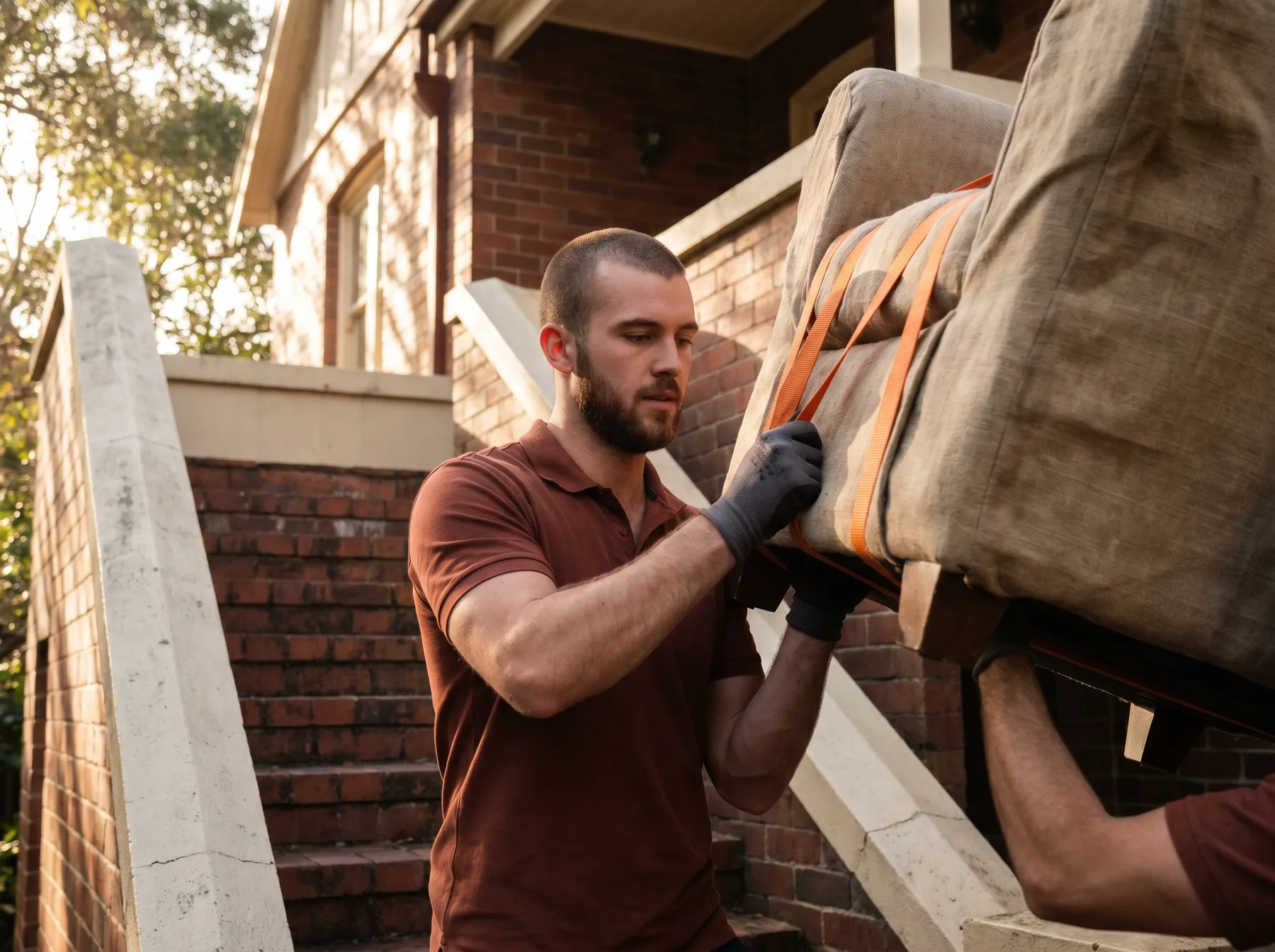
What the third mover actually does
The third mover isn't a passenger on the heavy pieces. They're the reason the other two never stop. On a relay, two movers run the carry while the third builds the load in the truck: tight, high, strapped in layers. When the carriers land a piece at the tailgate, they turn straight back up the slope, and the loader takes it from there. The line never breaks.
That's the difference between a crew that moves a house and a crew that moves furniture. It's also why our default for a 2-to-3-bed house on a steep street is 3 movers and 1 truck at $350 an hour rather than 2 at $250.
The honest arithmetic
Here's the worked example we give on the phone, with our real rates. Take a typical 3-bed brick house on a sloped Gladesville street, truck at the kerb below:
| Crew | Rate | Realistic day | The sum |
|---|---|---|---|
| 2 movers + 1 truck | $250/hr | 8 to 9 hours, carry-limited | $2,000 to $2,250 |
| 3 movers + 1 truck | $350/hr | 5.5 to 6 hours, relay running | $1,925 to $2,100 |
The dearer crew is the cheaper day, and you also get your evening back. This isn't always true: on a flat block with a driveway, two movers finish a 2-bed comfortably and the third would be padding. That's why we size from the carry, and why we'll happily tell you when the smaller crew is the right call. The numbers above are an illustration, not a quote; your house will have its own arithmetic and we'll do it with you on the callback.
Read your own driveway
Five questions that tell us (and you) most of what the day looks like:
- Would you reverse a tall truck up your drive? If you hesitated, the truck stands on the street.
- How many steps between the front door and the kerb, and do they turn?
- Where's the nearest flat spot a truck can stand legally for four hours?
- What's the widest piece in the house, and did it come in through a door or a window?
- Is the gate wider than your fridge? Measure both. Everyone's sure until they measure.
Send us the answers with your enquiry, or let the Both Ends planner ask them properly, including about the other end, because a flat loading end with a steep landing end is still a steep move.
One more honest note: steep-street skill is mostly preparation and patience, not heroics. Anyone promising to "make it quick" on a 45-degree drive is telling you they haven't seen one. We plan it, pace it, and the hours come out lower because nothing goes wrong.