


More than half of Gladesville's 8,209 homes are units, and most of them sit along or near Victoria Road and Wharf Road. A move in or out of one succeeds or fails on three bookings-and-checks that all happen before the truck starts: the lift, the dock, and the kerb. Get those right and a two-bedroom unit is a clean half-day. Get them wrong and you're paying a crew to wait for an elevator.
1. The lift: book it, then book the other one
Almost every newer block requires lift bookings for moves, and it's genuinely in your interest: a booked lift gets padded with protective curtains, held at your floor, and doesn't stop at every level with someone's groceries. Ask your building manager three things:
- Which window can I book, and how long is it? Two hours is tight for a 2-bed; ask for the morning block.
- Is there a move-in/move-out form or bond? Some schemes take a refundable deposit against damage.
- Can the lift be padded, or do the blankets live on site?
Then do it all again for the building at the other end. Two booked lifts beat one every time; the single most common delay we see is a landing-end lift nobody thought to book. Strata schemes are entitled to set these rules in their by-laws, and the NSW Government's strata living guidance explains how by-laws work if you want the legal backdrop.
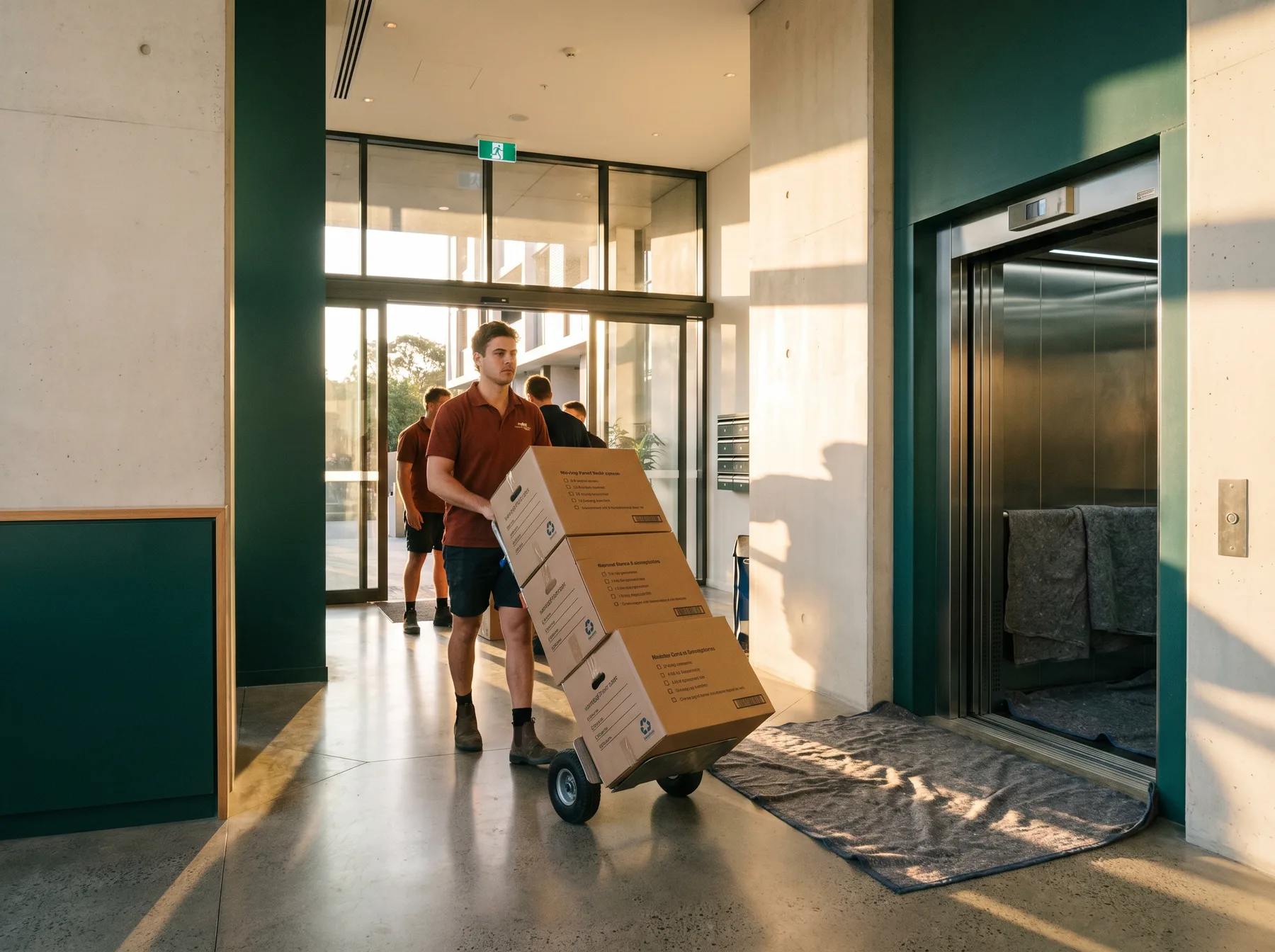
2. The dock: measure before you count on it
"The building has a loading dock" is the start of a question, not the end of one. Docks in corridor blocks vary in every dimension that matters: entry height (many basements clear 2.2 metres, a moving truck wants far more), bay length, and how far the dock sits from the lift lobby. What we check, and what you can check in five minutes with a tape measure or one photo of the signage:
- The height bar at the entry. If it says anything under 3 metres, our truck stays on the street and the dock becomes a trolley route.
- The dock-to-lift distance. Thirty metres of basement corridor changes the hours more than a flight of stairs does.
- Whether the dock is bookable, shared with waste collection, or first-come. First-come at 8am is code for "not available".
3. The kerb: clearways are the corridor's clock
Victoria Road is one of Sydney's busiest arterials and carries clearway restrictions along much of its length, part of a program Transport for NSW runs across the city's main corridors (Sydney Clearways Program, Transport for NSW). In a clearway window a stopped truck isn't just fined, it can be towed, and the signs change block by block and direction by direction.
What that means practically: if your block fronts Victoria Road or another signed stretch, the load happens outside the clearway hours or from a side street, and the day's start time is set backwards from those signs. This is not a problem we solve on the morning; it's a photo of your street's signs sent to us a week early, and a start time that respects it. Tell us the exact address and we do the sign-reading ourselves.
The one-line version of this whole guide: a unit move is three bookings, two measurements and one photo of a parking sign, all done the week before. The lifting was never the hard part.
4. The day itself
With the board set, here's how the hours actually run for a typical 2-bed corridor unit with a booked lift at one end:
| Phase | What's happening | Typical share of the day |
|---|---|---|
| Set up | Lift padded, doors wedged, trolley route walked | 15 to 20 min |
| Load | Cartons in trolley batches, furniture wrapped as it travels | 1.5 to 2.5 hrs |
| The crossing | The drive between ends, timed around the arterial's moods | Minutes locally |
| Unload and set | Cartons by room, bed assembled, lift blankets down | 1.5 to 2 hrs |
At $250 an hour for 2 movers and a truck, most well-prepared 2-bed corridor moves land in the 4-to-6-hour band, door to door. Preparation is the whole variance: the same unit with an unbooked lift and a mid-load clearway can stretch hours past that. The maths of the clock, in full: how the hourly rate works.
The week-before checklist
- Lift booked at both ends, morning window, confirmation in writing
- Move forms lodged with both building managers
- Dock height and booking checked, or ruled out honestly
- A photo of the street signs at both addresses, sent to us
- Cartons finished the night before: the lift window is for moving, not taping
That's the board. If you'd rather set it up interactively, the Both Ends planner asks these exact questions about both of your addresses and drafts the day for you. Or skip straight to the enquiry form, and we'll ask them on the callback.
Sources
- Strata living, NSW Government: how strata schemes and by-laws (including move rules and lift bookings) operate in NSW.
- Sydney Clearways Program, Transport for NSW: the program behind the clearway signs on Sydney's arterials, including why hours vary by corridor.